HIP-4 Outcome Markets on Hyperliquid - Multi-Outcome, Split & Negate
Table of Contents
- What Is HIP-4?
- The First Market: Recurring Binary BTC
- How the Recurring Binary Works
- Now Live: ETH, HYPE, and SOL Daily Outcomes
- Why "Limited-Feature" Matters
- How Outcome Trading Works
- Core Mechanics
- Opening Call Auction
- Settlement
- What You Can Trade
- Binary Yes/No Contracts
- Range Outcomes
- Bounded Options-Like Instruments
- Event-Based Contracts
- Multi-Outcome Markets Now Live (May 7, 2026)
- What Changed
- The First Multi-Outcome Market: Recurring BTC Price Range
- The Composability Advantage
- Unified Margin System
- Prime Brokerage-Style Capital Efficiency
- What This Means for Traders
- The Market Opportunity
- Prediction Markets
- Options and Structured Products
- Revenue Projections
- Current Status and Timeline
- How HIP-4 Fits the Bigger Picture
- Frequently Asked Questions
- What is HIP-4 outcome trading on Hyperliquid?
- Is HIP-4 live on mainnet yet?
- How is HIP-4 different from Polymarket or Kalshi?
- What types of contracts does HIP-4 support?
- How much revenue could HIP-4 generate for Hyperliquid?
- What are multi-outcome markets on Hyperliquid?
- How do split, negate, and merge work in HIP-4?
What Is HIP-4?
HIP-4 introduces outcome trading to Hyperliquid - a new contract primitive that sits alongside perpetual futures on HyperCore's trading engine. If perpetuals are about continuous price exposure with no expiration, outcome contracts are about specific events resolving at specific times within defined price boundaries.
Announced on February 2, 2026, HIP-4 went live on Hyperliquid mainnet on May 2, 2026 as a limited-feature initial release. The first market is a recurring binary outcome that settles daily at 06:00 UTC to the BTC mark price on Hyperliquid. The team has been explicit that this rollout is intended to validate the technical implementation, with additional features and markets being added in stages from here.
Info
HIP-4 brings fully collateralized contracts that settle within a fixed price range at a predetermined expiration date. These are not perpetuals with extra steps. They are a fundamentally different instrument designed for prediction markets, binary event contracts, bounded options, and anything else where you want to express a view on a discrete outcome.
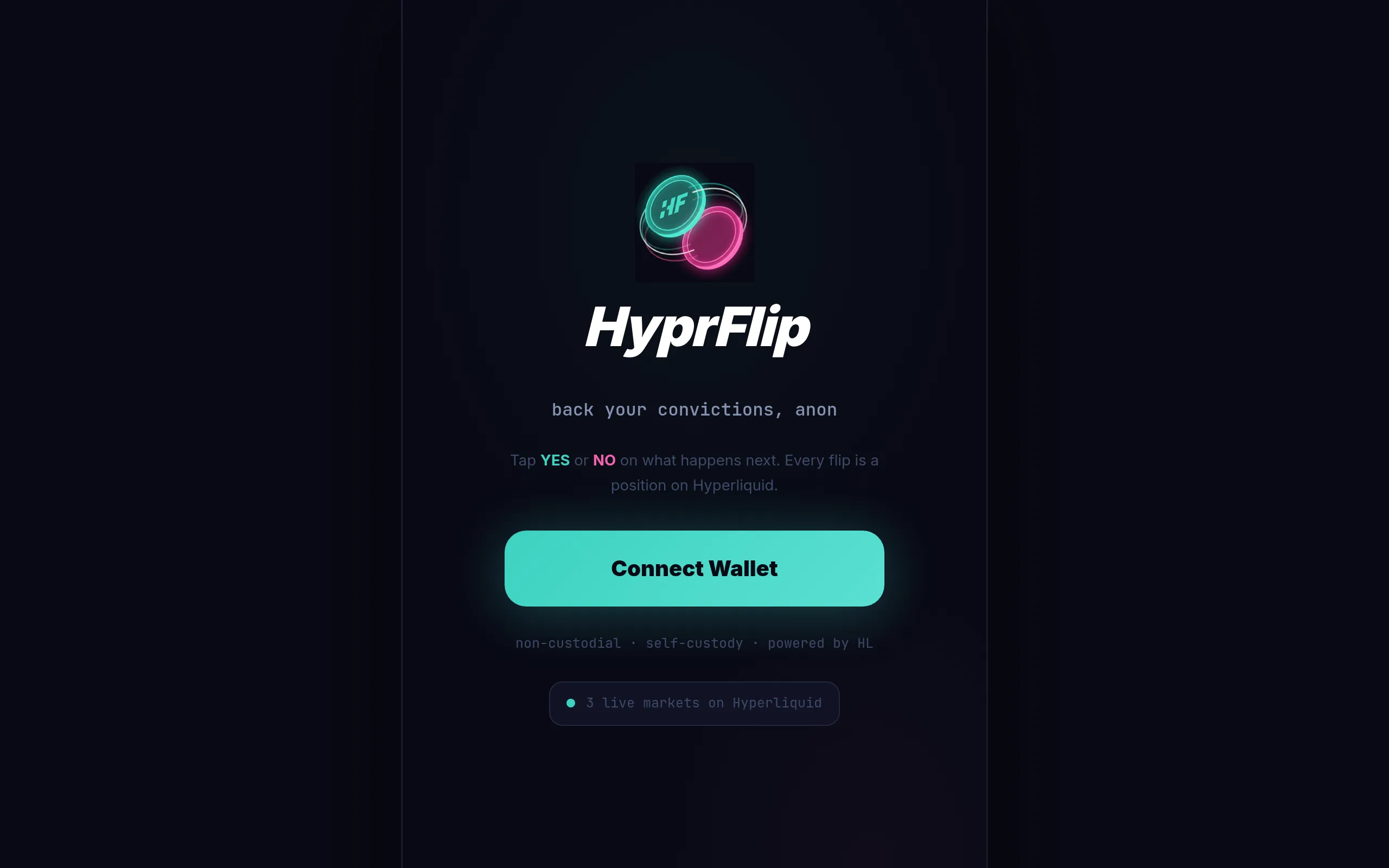
Pictured:  HyprFlip - a non-custodial binary outcome market built on Hyperliquid. Connect a wallet, tap YES or NO on what happens next, and every flip is a position settled on Hyperliquid.
The original announcement itself moved markets. HYPE jumped 10% on the day, reflecting the market's recognition that outcome trading opens entirely new revenue streams and use cases for the Hyperliquid ecosystem. The mainnet launch on May 2, 2026 confirms that the primitive is real, working, and now accepting live capital - even if the initial scope is intentionally narrow. Front-ends like HyprFlip are already wrapping these contracts in consumer-friendly interfaces.
The First Market: Recurring Binary BTC
The launch market is deliberately simple - a single recurring binary outcome contract on the Hyperliquid BTC mark price.
How the Recurring Binary Works
- Underlying: Hyperliquid BTC perp mark price
- Settlement time: Every day at 06:00 UTC
- Type: Binary - the contract resolves to either 0 or 1 USDC
- Recurring: A fresh contract is available each day, so traders do not have to wait for a new market to be listed
- Collateralization: 100% - no leverage, no liquidation, no margin calls
A recurring binary is the simplest possible test case for the new primitive. It strips away the complexity of one-off events (need for a sourced reference, dispute logic, exotic resolution rules) and runs on data the protocol already produces - the BTC mark price that powers Hyperliquid's largest perpetual market. That makes it a clean way to validate settlement, the opening call auction, and order book mechanics without exposing the system to oracle or resolution risk.
Info
Now Live: ETH, HYPE, and SOL Daily Outcomes
The recurring binary primitive is no longer BTC-only. Hyperliquid now runs recurring daily binary outcomes on ETH, HYPE, and SOL alongside the original BTC market. Each works identically to the launch contract: it is automatically deployed and settled daily at 06:00 UTC to the Hyperliquid mark price of the underlying perp (for example, the ETH-USDC mark price for the ETH outcome).
- BTC - daily binary settling to the BTC perp mark price
- ETH - daily binary settling to the ETH-USDC mark price
- HYPE - daily binary settling to the HYPE perp mark price
- SOL - daily binary settling to the SOL perp mark price
This is exactly the staged expansion the limited-feature launch was built toward - proving the primitive on a single internally-settled market, then replicating it across the next-largest perps with zero new oracle or resolution risk. All four use the same opening call auction, settlement engine, and full-collateralization model. The official contract specification for recurring outcomes documents the full set.
Why "Limited-Feature" Matters
The official framing is that the launch is a limited-feature initial release intended to validate the technical implementation. In practice, that means:
- A narrow market set - recurring binary and range outcomes on a handful of major assets, not yet the full suite of bounded-options and event-based instruments described in the original spec
- Settles to internal Hyperliquid data rather than external oracles or resolution committees
- Conservative parameters - small position sizes and capped activity are likely while the team monitors behavior
- Rolling out in stages - additional features and markets will be added as the team gains confidence in the production system
This is the same playbook Hyperliquid used for HIP-3 builder-deployed perps - ship a narrow first version, prove it works under real volume, then progressively expand the surface area. Anyone who wants to be early to outcome trading on a major derivatives venue can use this window to learn the mechanics before the broader rollout. The official HIP-4 contract specification covers the recurring outcome rules in detail.
How Outcome Trading Works
Understanding HIP-4 requires grasping how its contracts differ from the perpetual futures that Hyperliquid is known for.
Core Mechanics
Every HIP-4 outcome contract has four defining characteristics:
- Fixed expiration date - unlike perpetuals, which run indefinitely, outcome contracts settle at a specific point in time
- Fully collateralized - every position is 100% backed, meaning zero leverage and zero liquidation risk
- Predefined price range - contracts settle within a bounded range using objective reference data
- USDC settlement - canonical contracts settle in USDC, the aligned quote asset under AQAv2 (markets originally settled in USDH, now sunset)
The fully collateralized design is a deliberate choice. Prediction markets and event contracts are volatile around resolution - a binary contract can go from 50 cents to zero or one dollar in seconds. Leverage in that context would create cascading liquidations and broken markets. By requiring full collateralization, HIP-4 ensures that every contract can settle cleanly regardless of how extreme the price movement is.
Info
Opening Call Auction
New outcome markets do not just open for trading with no price discovery. HIP-4 uses a 15-minute opening call auction to establish initial pricing for each new contract. During this window, participants submit orders that are aggregated and matched at a single clearing price. This prevents the sniping and manipulation that plagues many prediction market launches, where the first few trades can set wildly inaccurate prices.
Settlement
When an outcome contract reaches its expiration date, it settles using objective reference data - the actual result of whatever event the contract tracks. A binary contract on whether BTC exceeds $150,000 by a given date settles based on the actual BTC price at expiration. A political outcome contract settles based on the verified result. The settlement process is deterministic: once the reference data is confirmed, all positions resolve automatically.
What You Can Trade
HIP-4 is not limited to a single contract type. It is a general-purpose primitive that supports a range of instruments.
Binary Yes/No Contracts
The simplest form: will something happen or not? Examples include whether a specific cryptocurrency will exceed a certain price by a given date, whether a protocol will launch a token before a deadline, or whether a governance proposal will pass. You buy at a price between 0 and 1 USDC, and the contract settles at either 0 or 1.
The launch HIP-4 market - the recurring binary BTC outcome described above - is exactly this shape, but resolves to a clean BTC mark price each day rather than a one-off event. Consumer front-ends are already wrapping the new primitive: HyprFlip is a non-custodial app (powered by HL) that exposes binary YES/NO markets as a "tap to back your conviction" UI. It is a good first stop if you want to see how the new HIP-4 contracts feel in a real product before placing trades directly through the order book.
Range Outcomes
More nuanced than binary. Instead of yes or no, range outcomes divide the possibility space into multiple buckets. For example, a range contract on ETH's price at year-end might have buckets for under $2,000, $2,000–$3,000, $3,000–$5,000, and over $5,000. You can buy into any bucket based on your view of the probability distribution.
Bounded Options-Like Instruments
HIP-4 contracts with defined price ranges can function similarly to options - offering exposure to price movements within a bounded corridor. While they are not traditional options with strike prices and Greeks, they provide comparable defined-risk, defined-reward exposure for traders who want asymmetric payoff profiles.
Event-Based Contracts
Sports results, political milestones, financial events, protocol metrics - anything with an objectively verifiable outcome can be structured as an HIP-4 contract. This is where the prediction market aspect shines, enabling markets on real-world events that traditional finance either cannot serve or serves poorly.
Tip
Outcome Trading Is Live on Hyperliquid
HIP-4 is now live on mainnet, starting with a recurring binary BTC outcome market. Set up your Hyperliquid account with our referral code and lock in a 4% lifetime fee discount across perps, spot, and outcome contracts.
Create Account with 4% OffMulti-Outcome Markets Now Live (May 7, 2026)
Five days after the binary launch, HIP-4 took a meaningful step forward. Multi-outcome markets - referred to in the protocol as "questions" - are now live, alongside split and merge support for binary markets.
This is the first non-trivial expansion of the HIP-4 surface, and it changes how outcome trading works in two important ways: markets can now express more than yes-or-no, and capital can move between related positions without locking up fresh collateral for each leg. For a deeper walkthrough of these mechanics, see our multi-outcome markets explainer.
What Changed
- Multi-outcome markets: A single market can now contain multiple linked outcomes (e.g. BTC ends below range, in range, above range) instead of being limited to a binary yes/no
- Split: Turn a single unit of collateral into a complete set of outcome tokens covering every bucket - one USDC becomes one token of each outcome, summing to one
- Negate: Express a short view on a specific outcome inside a multi-outcome market without selling the others
- Merge: Recombine a full set of outcome tokens back into the underlying collateral - the inverse of split
- Split and merge for binary markets: The same mechanics now apply to the recurring binary BTC market that launched on May 2
The combined effect is greater capital efficiency. Under the old binary model, expressing a nuanced multi-region view (BTC ends below $90k, between $90k–$110k, or above $110k) meant taking three separate positions and posting collateral against each. Under the multi-outcome model, you split once and trade the legs you want.
The First Multi-Outcome Market: Recurring BTC Price Range
The first live multi-outcome market is a recurring BTC price-range contract that settles daily at 06:00 UTC against the Hyperliquid BTC mark price - the same settlement mechanism as the launch binary, but with a richer payoff structure.
- Underlying: Hyperliquid BTC perp mark price
- Settlement time: Every day at 06:00 UTC
- Type: Multi-outcome with asymmetric upside, downside, and an intermediate range bucket relative to an initial reference price
- Recurring: A fresh contract is available each day, just like the binary
- Collateralization: 100% - no leverage, no liquidation, no margin calls
The asymmetric structure is the interesting part. Rather than a symmetric "above or below the strike" binary, the contract carves the price space into distinct upside, downside, and middle regions, each priced independently. Traders can express views like "BTC will probably stay roughly here" or "BTC is more likely to break out than break down" with a single trade rather than constructing a synthetic from multiple binary contracts.
Info
The full mechanics are documented in the official Hyperliquid contract specification for recurring outcomes.
The Composability Advantage
This is where HIP-4 gets genuinely interesting - and where it separates itself from every standalone prediction market.
Unified Margin System
HIP-4 outcome contracts run on the same HyperCore trading engine as Hyperliquid's perpetual futures. They share the same unified margin system, the same collateral pools, and the same account structure. This is not a bolted-on sidecar product; it is a native extension of the core platform.
What this means in practice: your outcome positions and your perp positions live in the same account and can automatically offset negatively correlated risks. If you are long BTC perps and also hold a binary contract that pays out if BTC drops below a certain level, HyperCore recognizes these as partially hedging positions. Your total margin requirement is lower than it would be holding each position in isolation.
Prime Brokerage-Style Capital Efficiency
This kind of cross-instrument margining is something that in traditional finance is only available through a prime brokerage - the kind of service that Goldman Sachs or Morgan Stanley offers to hedge funds with nine-figure accounts. HIP-4 brings that same capital efficiency to anyone with a Hyperliquid account.
Polymarket cannot do this. Kalshi cannot do this. No isolated prediction market can offer cross-margining with your futures positions because they do not have a futures engine. Hyperliquid already does, and HIP-4 integrates directly into it.
What This Means for Traders
For sophisticated traders, the composability means you can construct complex multi-instrument strategies without capital inefficiency. Hedge your perp positions with outcome contracts. Use binary contracts as tail-risk insurance. Build structured trades that combine directional perp exposure with event-driven outcome bets - all within a single margin account.
For simpler traders, it means you do not need to move capital between platforms. Your USDC balance works for perps, spot, and outcome contracts. One account, one interface, full flexibility.
The Market Opportunity
HIP-4 is not just a feature addition - it positions Hyperliquid to capture share of massive existing markets.
Prediction Markets
Polymarket and Kalshi have proven that there is real demand for prediction markets. Combined, they process $10–18 billion in monthly trading volume. But they operate as isolated platforms with limited composability, no cross-margining, and no integration with broader trading infrastructure. HIP-4 offers a structurally superior product for any trader who also trades futures or wants capital-efficient event exposure.
Options and Structured Products
The bounded options-like instruments that HIP-4 supports enter an even larger market. BTC and ETH options markets alone process $112–192 billion in monthly volume. HIP-4 contracts will not replace traditional options on day one, but they offer defined-risk, fully collateralized alternatives that are accessible without KYC, available 24/7, and composable with perp positions. Combined with options exchanges and structured products emerging on HyperEVM, Hyperliquid is building a comprehensive derivatives stack.
Revenue Projections
Analyst estimates project meaningful new revenue from HIP-4:
| Instrument Type | Estimated Monthly Revenue |
|---|---|
| Prediction Markets | $1.5–3 million |
| Options-Like Instruments | $11–15 million |
| Combined Annual Run Rate | $150–216 million |
These are incremental to Hyperliquid's existing perp revenue and the HIP-3 builder code revenue streams. If the projections hold, HIP-4 could represent the second-largest revenue source for the protocol after core perpetual trading.
Warning
Current Status and Timeline
As of June 2026, HIP-4 is in the following state:
- Announced: February 2, 2026
- Testnet: Live since Q1 2026 - used to stress-test settlement, the opening call auction, and composability with the perps engine
- Mainnet binary launch: May 2, 2026 - limited-feature initial release with a single recurring binary BTC outcome market settling daily at 06:00 UTC
- Multi-outcome upgrade: May 7, 2026 - "questions" go live with split, negate, and merge operations; binary markets gain split and merge; first multi-outcome market is a recurring BTC price-range contract
- Canonical outcome markets: May 25, 2026 - validator-deployed markets on offchain events go live via automated newsfeed software; validators vote on deployment and settlement based on unambiguous rules, correctness, and subjective quality
- Recurring outcomes expand beyond BTC: June 2026 - daily binary outcomes go live on ETH, HYPE, and SOL, each settling at 06:00 UTC to the underlying perp's Hyperliquid mark price
- Initial goal: Validate the technical implementation under real capital before expanding the surface area
- Next steps: Additional features and markets to be rolled out in stages
- HYPE market reaction: +10% on the original announcement day in February
This is the standard Hyperliquid playbook - ship a narrow, well-instrumented first version, prove it under real volume, then progressively expand. The May 7 multi-outcome upgrade is the first incremental step on that roadmap. Expect more contract types (bounded options-like instruments) and additional underlyings beyond BTC, on a timeline driven by what the team observes during this validation phase.
Trade the First HIP-4 Market on Hyperliquid
The recurring binary BTC outcome market is live on mainnet. Set up your Hyperliquid account now with our referral code and get a permanent 4% fee discount on all trading - perps, spot, and outcome contracts.
Sign Up with 4% DiscountHow HIP-4 Fits the Bigger Picture
HIP-4 is the third major expansion of Hyperliquid's product surface in less than a year:
- HyperEVM brought general-purpose smart contracts to the chain, enabling a full DeFi ecosystem - read our HyperEVM guide
- HIP-3 enabled permissionless perpetual market deployment, turning Hyperliquid from a product into a platform
- HIP-4 adds outcome trading, extending the platform into prediction markets and bounded options
Each expansion leverages HyperCore's existing infrastructure while opening entirely new addressable markets. The cumulative effect is a protocol that can serve perpetual traders, DeFi users, prediction market participants, and options traders - all within a single, composable ecosystem. No other DeFi protocol offers this breadth of trading instruments on a single L1 with unified margin.
For HYPE token holders, each new instrument type represents an additional fee revenue stream that feeds into the buyback and burn mechanism. More instruments, more volume, more fees, more HYPE burned.
Start Trading on Hyperliquid Today
Perps, spot, builder markets, and soon outcome trading - all on one platform. Use our referral code for a 4% lifetime fee discount across every product.
Claim Your 4% Fee DiscountFrequently Asked Questions
What is HIP-4 outcome trading on Hyperliquid?
HIP-4 introduces outcome trading to Hyperliquid - fully collateralized contracts that settle within a fixed price range at a predetermined expiration date. It is a general-purpose primitive that supports prediction markets, binary yes/no contracts, bounded options-like instruments, and event-based trading. Unlike perpetuals, outcome contracts have fixed expiration dates and zero leverage, meaning there is no liquidation risk.
Is HIP-4 live on mainnet yet?
Yes. HIP-4 outcome markets went live on Hyperliquid mainnet on May 2, 2026 as a limited-feature initial release. The first market is a recurring binary outcome that settles daily at 06:00 UTC to the BTC mark price on Hyperliquid. The team has stated this initial rollout is intended to validate the technical implementation, with additional features and markets being added in stages. Get a 4% fee discount on Hyperliquid
How is HIP-4 different from Polymarket or Kalshi?
HIP-4 runs natively on HyperCore, Hyperliquid's L1 trading engine, rather than as a standalone application. This means outcome positions share collateral pools with your perpetual positions, enabling prime brokerage-style composability - automatically offsetting negatively correlated risks across instruments. Isolated prediction markets like Polymarket cannot offer this cross-margin efficiency. HIP-4 canonical markets settle in USDC (the aligned quote asset under AQAv2) and support a broader range of instruments beyond simple binary outcomes.
What types of contracts does HIP-4 support?
HIP-4 supports multiple contract types: binary yes/no contracts for simple event prediction, range outcomes for multi-bucket scenarios, bounded options-like instruments with defined price ranges, and event-based contracts for sports results, political milestones, and financial events. All contracts are fully collateralized, settle within predefined price ranges, and have fixed expiration dates.
How much revenue could HIP-4 generate for Hyperliquid?
Analyst estimates project $1.5–3 million monthly from prediction market-style contracts and $11–15 million monthly from options-like instruments, for a combined annual run rate of $150–216 million. For context, Polymarket and Kalshi combined process $10–18 billion in monthly volume, while BTC and ETH options markets alone handle $112–192 billion monthly. Even capturing a small fraction of these markets represents significant new revenue for the Hyperliquid ecosystem.
What are multi-outcome markets on Hyperliquid?
Multi-outcome markets - referred to in the protocol as "questions" - bundle related outcomes into one market instead of running them as independent binary contracts. The outcomes are tied together via split and negate operations, so a single unit of collateral can be transformed across positions without locking up extra capital for each leg. The first multi-outcome market is a recurring BTC price-range market that settles daily at 06:00 UTC against the Hyperliquid BTC mark price, with asymmetric upside, downside, and an intermediate range bucket.
How do split, negate, and merge work in HIP-4?
Split takes a single collateral unit and turns it into a complete set of outcome tokens covering every bucket of a multi-outcome market - so one USDC becomes one token of each outcome, summing to one. Merge does the reverse: holding the full set lets you reclaim the underlying collateral. Negate is the multi-outcome version of going short a specific bucket without selling the others. Together these three operations make multi-outcome markets capital-efficient: you only pay collateral once, even when holding nuanced views across several outcomes.
Important
Frequently Asked Questions
HIP-4 introduces outcome trading to Hyperliquid - fully collateralized contracts that settle within a fixed price range at a predetermined expiration date. It is a general-purpose primitive that supports prediction markets, binary yes/no contracts, bounded options-like instruments, and event-based trading. Unlike perpetuals, outcome contracts have fixed expiration dates and zero leverage, meaning there is no liquidation risk.
Yes. HIP-4 outcome markets went live on Hyperliquid mainnet on May 2, 2026 as a limited-feature initial release. The first market is a recurring binary outcome that settles daily at 06:00 UTC to the BTC mark price on Hyperliquid. The team has stated this initial rollout is intended to validate the technical implementation, with additional features and markets being added in stages.
The first HIP-4 market is a recurring binary outcome contract that settles daily at 06:00 UTC to the Hyperliquid BTC mark price. It is fully collateralized with no leverage and no liquidation risk. The recurring structure means a fresh contract is available each day, giving traders consistent access to a simple yes/no event without needing a new market to be deployed manually.
HIP-4 runs natively on HyperCore, Hyperliquid's L1 trading engine, rather than as a standalone application. This means outcome positions share collateral pools with your perpetual positions, enabling prime brokerage-style composability - automatically offsetting negatively correlated risks across instruments. Isolated prediction markets like Polymarket cannot offer this cross-margin efficiency. HIP-4 canonical markets settle in USDC (the aligned quote asset under AQAv2) and support a broader range of instruments beyond simple binary outcomes.
HIP-4 supports multiple contract types: binary yes/no contracts for simple event prediction, range outcomes for multi-bucket scenarios, bounded options-like instruments with defined price ranges, and event-based contracts for sports results, political milestones, and financial events. All contracts are fully collateralized, settle within predefined price ranges, and have fixed expiration dates. The initial mainnet rollout starts with a single recurring binary BTC market, with more contract types and markets following in stages.
Analyst estimates project $1.5-3 million monthly from prediction market-style contracts and $11-15 million monthly from options-like instruments. For context, Polymarket and Kalshi combined process $10-18 billion in monthly volume, while BTC/ETH options markets alone handle $112-192 billion monthly. Even capturing a small fraction of these markets represents significant new revenue for the Hyperliquid ecosystem.
Multi-outcome markets (also called questions) bundle related outcomes into one market instead of running them as independent binary contracts. The outcomes are tied together via split and negate operations, so a single unit of collateral can be transformed across positions without locking up extra capital for each leg. The first multi-outcome market is a recurring BTC price-range market that settles daily at 06:00 UTC against the Hyperliquid BTC mark price, with asymmetric upside, downside, and an intermediate range bucket.
Yes. After launching with BTC, Hyperliquid expanded recurring binary outcomes to ETH, HYPE, and SOL. Like the BTC daily outcome, each is automatically deployed and settled daily at 06:00 UTC to the Hyperliquid mark price of the underlying perp - for example, the ETH-USDC mark price for the ETH outcome. They use the same opening call auction, settlement engine, and full-collateralization model as the original BTC market, with no external oracle dependency.
Split takes a single collateral unit and turns it into a complete set of outcome tokens covering every bucket of a multi-outcome market - so one USDC becomes one token of each outcome, summing to one. Merge does the reverse: holding the full set lets you reclaim the underlying collateral. Negate is the multi-outcome version of going short a specific bucket without selling the others. Together these three operations make multi-outcome markets capital-efficient: you only pay collateral once, even when holding nuanced views across several outcomes.
Disclaimer: This content is for informational purposes only and does not constitute financial advice. Trading perpetual futures involves substantial risk of loss. Past performance is not indicative of future results. Always do your own research before trading. This site contains referral links - see our disclosure for details.
Ready to Start Trading?
Join Hyperliquid with our referral link and get a 4% lifetime fee discount. No KYC, no email - just connect your wallet and trade.
Start Trading - Save 4%