Is Hyperliquid Safe? Security, Risks, and What You Need to Know (2026)
Table of Contents
- Non-Custodial Architecture: What It Actually Means
- Smart Contract and Protocol Audit Status
- Hyperliquid's Approach to Security
- What We Know About Audits
- Protocol-Level Risks: What Could Go Wrong
- 1. Validator and Consensus Risk
- 2. Bridge Risk
- 3. Oracle and Price Feed Risk
- 4. Liquidation Cascade Risk
- The Liquidation Engine and HLP Backstop
- What Hyperliquid Does NOT Protect Against
- Historical Incident Record
- How Hyperliquid Compares to Centralized Exchange Risk
- Practical Security Recommendations
- The Bottom Line
 Hyperliquid
"Is Hyperliquid safe?" is the most important question any trader should ask before depositing funds into a new platform. The honest answer is nuanced: Hyperliquid has a strong security track record and a non-custodial architecture that eliminates some of the biggest risks in crypto trading - but like every DeFi protocol, it carries risks that you need to understand before committing capital.
This guide breaks down every dimension of Hyperliquid's security: what protects your funds, what could go wrong, and what the protocol does and does not guarantee. No hype, no sugarcoating - just the facts you need to make an informed decision. New to the platform entirely? Pair this with our beginner-friendly Hyperliquid for Dummies walkthrough.
Info
Quick Summary - Hyperliquid Security at a Glance
- Custody model: Non-custodial - your funds stay under your wallet's control, not Hyperliquid's
- Track record: No protocol-level hacks or fund losses since launch in late 2023
- Cumulative volume: Over $1 trillion processed as of March 2026
- Validator set: Proof-of-stake consensus with staked HYPE tokens securing the network
- Liquidation backstop: HLP vault absorbs liquidations to prevent cascading failures
- Insurance fund: Protocol-owned, built from liquidation proceeds - not user deposits
- Smart contract audits: Security reviews conducted, though comprehensive public reports are limited
- What it does NOT insure: Personal wallet compromises, trading losses, bridge failures outside Hyperliquid's control
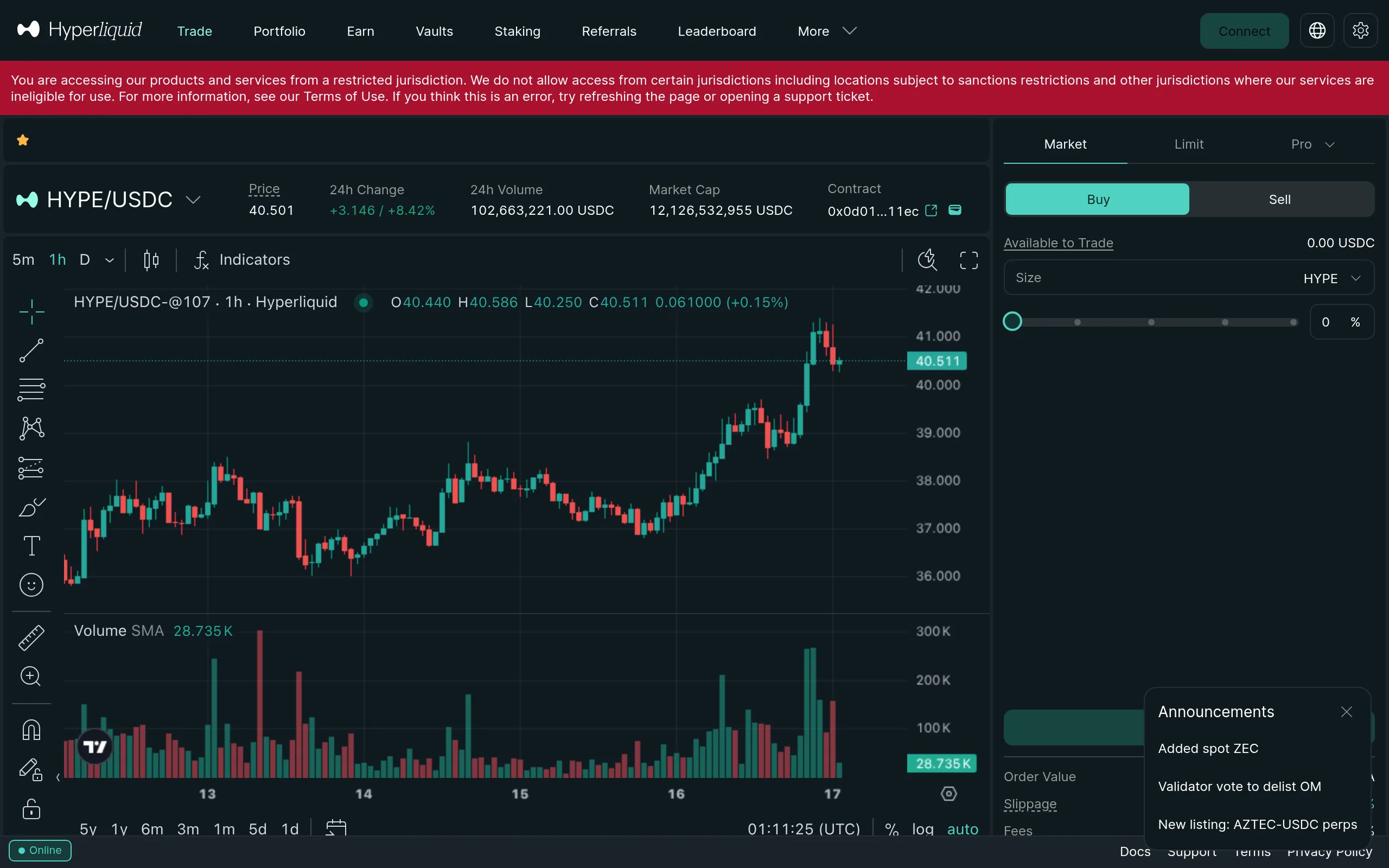
Non-Custodial Architecture: What It Actually Means
The single most important security feature of Hyperliquid is that it is non-custodial. When you deposit USDC into Hyperliquid, you are not handing your money to a company. You are bridging assets to a decentralized Layer 1 blockchain where your funds are controlled by your own wallet's private keys.
This is a fundamentally different risk profile from centralized exchanges like Binance, Coinbase, or the now-defunct FTX. On a centralized exchange, you deposit funds into wallets controlled by the company. If that company is hacked, mismanages funds, becomes insolvent, or faces regulatory seizure, your deposits are at risk. The collapse of FTX in November 2022 - where over $8 billion in customer funds disappeared - is the most extreme example of custodial risk.
On Hyperliquid, none of those scenarios apply. There is no central entity holding a pool of user deposits. There is no CEO who can misallocate your funds. There is no corporate bank account that regulators can freeze. When you connect your wallet to app.hyperliquid.xyz and deposit, your funds move to a protocol - not a company's balance sheet.
However, non-custodial does not mean risk-free. It means the risks are different. Instead of trusting a company, you are trusting smart contracts, validators, and your own wallet security. For a deeper explanation of how Hyperliquid works — including its on-chain order book and HyperBFT consensus — see our architecture guide. The following sections break down each of these risk vectors honestly.
Smart Contract and Protocol Audit Status
Every DeFi protocol is ultimately a set of smart contracts - code that executes automatically on a blockchain. If that code has a bug, an attacker can potentially exploit it to drain funds. This is smart contract risk, and it is the most significant technical risk in any DeFi protocol.
Hyperliquid's Approach to Security
Hyperliquid's architecture is somewhat unusual in the DeFi landscape. Rather than deploying a set of Solidity smart contracts on Ethereum or another general-purpose chain, Hyperliquid runs its own purpose-built Layer 1 blockchain. The core matching engine, margin system, and liquidation logic are implemented as part of the chain's native execution environment - not as user-deployed smart contracts on a shared EVM.
This design choice has security implications in both directions:
Advantages:
- The attack surface is narrower than protocols deployed on shared chains, because there are fewer external contract interactions to exploit
- The team controls the entire stack, which allows for faster patching if vulnerabilities are discovered
- There is no reliance on third-party smart contracts (like AMM pools or external oracles) that could introduce vulnerabilities
Trade-offs:
- The codebase is largely proprietary and not fully open-source, which limits the number of independent eyes reviewing it
- Unlike protocols with multiple published audits from firms like Trail of Bits or OpenZeppelin, Hyperliquid has not made comprehensive third-party audit reports widely available to the public
- Users are placing trust in the Hyperliquid team's internal security practices
What We Know About Audits
Hyperliquid's bridge contracts - the critical infrastructure that moves USDC between Arbitrum and the Hyperliquid L1 - have undergone security reviews. The bridge is the highest-risk component, as it is the gateway for all user deposits and withdrawals. The team has stated that security is a top priority and that the protocol undergoes ongoing security review.
That said, the absence of publicly accessible, comprehensive audit reports from well-known third-party firms is a legitimate concern. Many DeFi protocols publish full audit reports as a transparency measure. Hyperliquid's approach has been more guarded, relying on its operational track record and the economic security of its validator set rather than public audit documentation.
Start Trading with Confidence
Hyperliquid's non-custodial architecture means your funds stay under your control. Get a 4% lifetime fee discount when you sign up through our referral link.
Join Hyperliquid - Save 4%Protocol-Level Risks: What Could Go Wrong
No protocol is without risk. Here are the specific risk vectors that apply to Hyperliquid, assessed honestly.
1. Validator and Consensus Risk
Hyperliquid runs a proof-of-stake Layer 1 blockchain with a validator set secured by staked HYPE tokens. The security of the network depends on the economic weight and honest behavior of these validators.
The risk: If a supermajority of validators colluded or were compromised, they could theoretically censor transactions, halt the chain, or attempt to manipulate state. In the early phases of the network, the validator set was relatively small and largely operated by the Hyperliquid team, which concentrated trust. As of March 2026, the validator set has expanded, but it remains smaller than mature networks like Ethereum.
Mitigating factors: Validators stake significant amounts of HYPE, creating economic incentive alignment. Malicious behavior would result in slashing (loss of staked tokens), making attacks economically costly. The ongoing decentralization of the validator set continues to strengthen this security layer.
2. Bridge Risk
The bridge between Arbitrum and Hyperliquid's L1 is the critical infrastructure that handles all deposits and withdrawals. Bridges are historically one of the highest-risk components in crypto - major bridge exploits (Wormhole, Ronin, Nomad) have resulted in billions in losses across the industry.
The risk: A vulnerability in the bridge smart contracts could allow an attacker to mint unbacked assets on Hyperliquid or drain the bridge's USDC reserves on Arbitrum. This is a severe, existential-level risk.
Mitigating factors: Hyperliquid's bridge is purpose-built for a single asset (USDC) on a single route (Arbitrum to Hyperliquid L1), which is a much simpler design than general-purpose bridges that support multiple assets and chains. Simpler bridges have a smaller attack surface. The bridge contracts have undergone security review, and the validator set provides an additional security layer for bridge operations.
3. Oracle and Price Feed Risk
Perpetual futures exchanges depend on accurate price feeds (oracles) to calculate mark prices, trigger liquidations, and settle funding rates. If an oracle is manipulated, it could trigger unjust liquidations or allow market manipulation.
The risk: Oracle manipulation could cause traders to be liquidated at artificial prices, or could allow sophisticated attackers to extract value from the protocol.
Mitigating factors: Hyperliquid uses a combination of on-chain order book data and external price feeds, with multiple safeguards against manipulation including mark price smoothing and price band protections. The protocol's design makes it resistant to the single-source oracle attacks that have plagued AMM-based DEXs.
4. Liquidation Cascade Risk
In extreme market volatility, a cascade of liquidations can create a feedback loop: falling prices trigger liquidations, liquidation sales push prices lower, which triggers more liquidations. This can drain protocol insurance funds and leave the system with bad debt.
The risk: A black swan market event could overwhelm the liquidation engine and insurance fund, potentially socializing losses across remaining users.
Mitigating factors: Hyperliquid's HLP vault serves as the primary backstop for liquidations. HLP is a protocol-owned vault that absorbs liquidated positions, providing deep liquidity to prevent cascading failures. The protocol also maintains an insurance fund built from liquidation proceeds. Additionally, Hyperliquid's maximum leverage is capped at 50x (lower on most assets), which limits the severity of potential cascading liquidations compared to exchanges offering 100x or higher. For a detailed explanation of how liquidation works on Hyperliquid, including margin calculations and avoidance strategies, see our dedicated guide.
The Liquidation Engine and HLP Backstop
Understanding how Hyperliquid handles liquidations is key to evaluating its safety under stress.
When a trader's position is liquidated, the position needs to be taken over by someone. On many exchanges, this falls to an insurance fund that can be depleted. Hyperliquid takes a different approach with the HLP (Hyperliquid Liquidity Provider) vault.
How it works:
- A trader's margin falls below the maintenance requirement, triggering liquidation
- The liquidation engine closes the position at the current market price
- The HLP vault absorbs the liquidated position as a market-making counterparty
- If the liquidation results in a surplus (the position had remaining margin), the surplus goes to the insurance fund
- If the liquidation results in a deficit (bad debt), the HLP vault absorbs the loss
This creates a robust backstop: the HLP vault is capitalized by liquidity providers who earn trading fees and funding payments in exchange for taking on liquidation absorption risk. As of March 2026, the HLP vault holds significant capital - a buffer that would need to be entirely depleted before any socialization of losses could occur.
Tip
What Hyperliquid Does NOT Protect Against
Transparency requires stating clearly what is outside Hyperliquid's security model:
- Your wallet being compromised: If someone gains access to your private keys or seed phrase, they can withdraw your funds from Hyperliquid. The protocol cannot prevent this. See our crypto trading security guide for wallet protection best practices.
- Trading losses: Hyperliquid is a trading venue, not an investment product. Leverage trading carries inherent risk of loss, including total loss of deposited margin. No protocol feature protects you from bad trades.
- Phishing attacks: Fake Hyperliquid websites can trick you into signing malicious transactions. Always access Hyperliquid through a saved bookmark, never through links in emails or social media.
- External bridge failures: If you use a third-party bridge (Across, Synapse, etc.) to move funds to Arbitrum before depositing, failures in those bridges are outside Hyperliquid's control.
- Regulatory actions: While Hyperliquid's decentralized architecture makes it resistant to direct regulatory enforcement, frontends could be restricted in certain jurisdictions. Regulators may also issue consumer warnings — for instance, Singapore's MAS placed Hyperliquid on its Investor Alert List, which flags it as not locally licensed but is not a ban. Access to the protocol itself remains permissionless.
- Token price risk: If you hold HYPE or other tokens, their price can decline. This is market risk, not a protocol security issue.
Historical Incident Record
As of March 2026, Hyperliquid's security track record is strong:
- Zero protocol-level hacks since launch in late 2023
- Zero fund losses attributable to smart contract bugs or bridge exploits
- Over $1 trillion in cumulative volume processed without a security incident affecting user funds
- Continuous uptime - the protocol has maintained high availability through multiple market volatility events, including the sharp sell-offs of 2024 and 2025
There have been isolated incidents worth noting for completeness:
- Occasional frontend downtime: Like most web applications, the Hyperliquid frontend has experienced brief periods of degraded performance during extreme traffic spikes. The protocol itself continued operating - traders with API access could still execute orders. This is a user experience issue, not a security issue.
- Market manipulation attempts: Individual markets on Hyperliquid have experienced attempted manipulation (pump-and-dump schemes on low-liquidity tokens, coordinated liquidation hunts). These are common across all exchanges and are a feature of adversarial markets, not a protocol vulnerability. Hyperliquid's team has responded by adjusting parameters on affected markets.
It is critical to note that past performance does not guarantee future security. A protocol that has never been exploited can still be exploited tomorrow. The track record is evidence of competent engineering and operational practices, but it is not proof of invulnerability.
How Hyperliquid Compares to Centralized Exchange Risk
For context, here is how Hyperliquid's risk profile compares to the risks of keeping funds on a centralized exchange:
| Risk Factor | Hyperliquid (DEX) | Centralized Exchange (CEX) |
|---|---|---|
| Counterparty / insolvency risk | None - non-custodial | High - exchange holds your funds |
| Account freeze risk | None - permissionless | Possible - regulatory or compliance |
| Smart contract risk | Yes - DeFi-inherent | Minimal - centralized infrastructure |
| Bridge risk | Yes - Arbitrum bridge | Minimal - internal transfers |
| Validator risk | Yes - PoS consensus | No - centralized servers |
| Personal wallet security | Your responsibility | Exchange handles custody |
| Insurance / fund recovery | Limited to insurance fund + HLP | Some exchanges offer insurance (varies) |
Neither model is categorically "safer." They present different risk profiles. Self-custody eliminates counterparty risk but introduces personal responsibility for wallet security. Exchange custody removes the wallet security burden but introduces trust in a third party. For a detailed comparison, see our Hyperliquid vs Binance breakdown.
Understanding Hyperliquid's fee structure is also part of assessing the platform holistically - lower fees mean less friction, but the security of your funds is always the first consideration.
Trade with Self-Custody
Hyperliquid gives you CEX-level trading performance without handing your funds to a third party. Sign up with our referral code for a 4% lifetime fee discount.
Start Trading on HyperliquidPractical Security Recommendations
Based on everything above, here is what a prudent trader should do:
- Use a hardware wallet (Ledger or Trezor) connected to MetaMask or Rabby when interacting with Hyperliquid. This is your strongest defense against wallet compromise.
- Never deposit more than you can afford to lose. This applies to every DeFi protocol, no matter how strong the track record.
- Bookmark app.hyperliquid.xyz and only access the platform through that bookmark. Never click links in emails, DMs, or social media claiming to be Hyperliquid.
- Diversify across platforms if you hold significant capital. Do not keep all your trading funds in a single protocol.
- Monitor your token approvals regularly using revoke.cash. Revoke any unused approvals.
- Stay informed. Follow Hyperliquid's official channels for security updates and announcements.
- Read our full crypto trading security guide for comprehensive wallet, network, and operational security practices.
The Bottom Line
Is Hyperliquid safe? It is as safe as a non-custodial DeFi protocol can reasonably be in 2026. The architecture eliminates the biggest single risk in crypto trading - counterparty risk - and the protocol has a clean track record across more than two years of operation and over $1 trillion in volume. The HLP vault provides a meaningful backstop against liquidation cascades, and the proof-of-stake validator set continues to decentralize.
But "safe" is relative. Smart contract risk, bridge risk, and validator risk are real. The absence of comprehensive public audit reports is a legitimate concern. And personal wallet security is entirely in your hands.
The right question is not "is Hyperliquid safe?" in absolute terms. It is: "do the security trade-offs of self-custody DeFi trading align with my risk tolerance and my ability to manage my own wallet security?" For many traders, the answer is yes - and Hyperliquid is among the strongest options in that category.
Get 4% Fee Discount on HyperliquidFrequently Asked Questions
Hyperliquid is a non-custodial exchange, meaning you retain control of your funds through your own wallet. The protocol has processed billions in volume without a protocol-level fund loss. However, like all DeFi protocols, it carries smart contract risk, bridge risk, and validator risk. It is safer than custodial exchanges in some respects (no counterparty risk) but requires you to manage your own wallet security.
As of March 2026, Hyperliquid has not experienced a protocol-level hack or fund loss. The platform has operated since late 2023 and processed over $1 trillion in cumulative volume. However, past performance does not guarantee future security. Users should always practice good wallet hygiene and never deposit more than they can afford to lose.
Hyperliquid's smart contracts and bridge infrastructure have undergone security reviews. However, unlike some DeFi protocols that publish multiple third-party audit reports, Hyperliquid has not made comprehensive public audit reports widely available. The protocol's security is also supported by its validator set and the economic security of staked HYPE tokens.
No. Hyperliquid is a non-custodial, permissionless protocol. There is no centralized entity that can freeze, seize, or block your funds. You can withdraw at any time by signing a transaction with your wallet. This is a fundamental difference from centralized exchanges like Binance or Coinbase, which can freeze accounts for regulatory or compliance reasons.
Disclaimer: This content is for informational purposes only and does not constitute financial advice. Trading perpetual futures involves substantial risk of loss. Past performance is not indicative of future results. Always do your own research before trading. This site contains referral links - see our disclosure for details.
Ready to Start Trading?
Join Hyperliquid with our referral link and get a 4% lifetime fee discount. No KYC, no email - just connect your wallet and trade.
Start Trading - Save 4%