Hyperliquid Liquidation Explained: How It Works & How to Avoid It (2026)
Table of Contents
- What Is Liquidation?
- How Liquidation Works on Hyperliquid
- 1. Margin Ratio Deteriorates
- 2. Maintenance Margin Threshold
- 3. Liquidation Engine Takes Over
- 4. Partial Liquidation
- How to Calculate Your Liquidation Price
- Worked Example: 10x Long BTC at $50,000
- How Leverage Changes the Liquidation Distance
- Cross-Margin vs Isolated Margin: How They Affect Liquidation
- Cross-Margin Mode
- Isolated Margin Mode
- 5 Strategies to Avoid Liquidation
- 1. Use Lower Leverage
- 2. Always Set a Stop-Loss
- 3. Add Margin to Open Positions
- 4. Size Positions Relative to Your Account
- 5. Monitor Funding Rates
- What Happens After Liquidation
- Margin Is Lost
- Insurance Fund
- No Negative Balance
- After a Liquidation - What to Do
Liquidation is the single most costly event in leveraged trading. It means the exchange has forcibly closed your position because your losses consumed too much of your collateral. On Hyperliquid, understanding exactly when and how liquidation triggers is the difference between managing risk and watching your margin disappear.
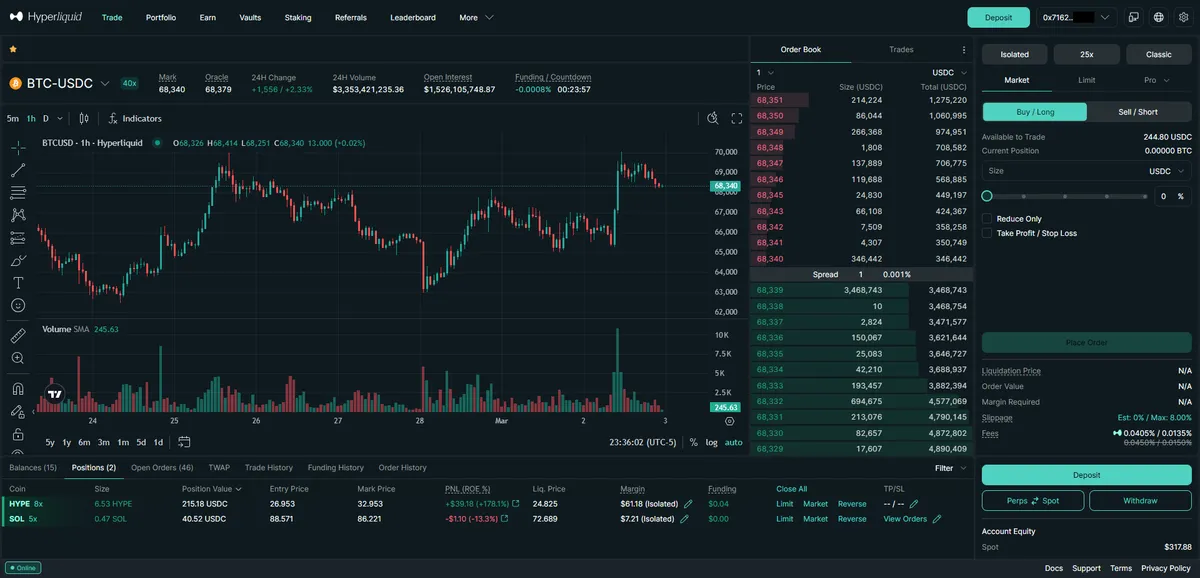
This guide covers the full liquidation mechanics on app.hyperliquid.xyz: how the liquidation engine works, how to calculate your liquidation price, how cross-margin and isolated-margin modes change the equation, and five concrete strategies to avoid forced liquidation.
If you are new to perpetual futures, start with our beginner trading guide first, then come back here.
What Is Liquidation?
When you open a leveraged position on a perpetual futures exchange, you put up a fraction of the total position value as margin (collateral). That margin absorbs any unrealized losses on the trade. If the market moves far enough against you that your remaining margin drops below the maintenance margin requirement, the exchange steps in and forcibly closes your position. That forced closure is a liquidation.
Think of it this way: the exchange lent you buying power through leverage. Your margin is the deposit guaranteeing you can cover losses. When the deposit runs too low, the exchange takes it back before the position goes negative.
Key terms you need to know:
- Initial margin - the collateral you put up when opening a position. At 10x leverage on a $10,000 position, your initial margin is $1,000.
- Maintenance margin - the minimum collateral required to keep the position open. On Hyperliquid, this is typically around 0.5% of the position's notional value for major assets, though it scales with position size.
- Liquidation price - the exact price at which your margin drops to the maintenance margin level and liquidation is triggered.
- Mark price - the reference price Hyperliquid uses to calculate unrealized PnL and trigger liquidations. It is derived from the oracle price, not the last traded price, which protects against wicks and manipulation.
Info
How Liquidation Works on Hyperliquid
Hyperliquid's liquidation engine monitors every open position in real time. Here is the sequence of events when a position approaches liquidation:
1. Margin Ratio Deteriorates
As the mark price moves against your position, your unrealized loss grows and your effective margin shrinks. Hyperliquid displays your current margin ratio and liquidation price in the positions panel.
2. Maintenance Margin Threshold
When your remaining margin falls to the maintenance margin level, the liquidation engine flags the position. On Hyperliquid the maintenance margin rate for BTC and ETH starts at approximately 0.5% of notional value, but increases for larger position sizes to manage risk.
3. Liquidation Engine Takes Over
Once triggered, the liquidation engine closes your position. Hyperliquid uses a backstop liquidity mechanism - the position is taken over at the bankruptcy price (the price at which your margin is exactly zero). Any margin remaining between your liquidation price and the bankruptcy price goes to the insurance fund, which exists to cover cases where liquidations cannot be filled at favorable prices.
4. Partial Liquidation
For large positions, Hyperliquid may use partial liquidation - closing only enough of the position to bring the margin ratio back above the maintenance requirement. This is better for the trader because it preserves the remaining position rather than force-closing the entire thing.
How to Calculate Your Liquidation Price
Your liquidation price depends on three variables: your entry price, your leverage, and the maintenance margin rate. Here is the simplified formula for isolated margin positions:
Long position:
Liquidation Price = Entry Price × (1 − 1/Leverage + Maintenance Margin Rate)
Short position:
Liquidation Price = Entry Price × (1 + 1/Leverage − Maintenance Margin Rate)
Worked Example: 10x Long BTC at $50,000
Let's walk through a concrete example. You open a long BTC-USD position at $50,000 with 10x leverage and a 0.5% maintenance margin rate:
| Parameter | Value |
|---|---|
| Entry price | $50,000 |
| Leverage | 10x |
| Position size | $50,000 (notional) |
| Initial margin | $5,000 (10% of notional) |
| Maintenance margin rate | 0.5% |
Liquidation price = $50,000 × (1 − 1/10 + 0.005) = $50,000 × 0.905 = $45,250
That means BTC needs to drop approximately 9.5% from your entry price to trigger liquidation. Your $5,000 initial margin absorbs the first $4,750 of losses; the remaining $250 (0.5% maintenance margin) is the buffer before the engine takes over.
Tip
How Leverage Changes the Liquidation Distance
The higher your leverage, the closer your liquidation price sits to your entry:
| Leverage | Approx. Liquidation Distance (Long) |
|---|---|
| 2x | ~50% below entry |
| 5x | ~19.5% below entry |
| 10x | ~9.5% below entry |
| 20x | ~4.5% below entry |
| 50x | ~1.5% below entry |
Warning
Hyperliquid displays the exact liquidation price for every open position in the trading interface. Always verify it there - the formulas above are approximations, and the actual liquidation price accounts for fees, funding rate accruals, and position-size-dependent maintenance margin tiers.
Trade Smarter on Hyperliquid
Get a 4% lifetime fee discount on all trades - lower fees mean more margin buffer.
Join HyperliquidCross-Margin vs Isolated Margin: How They Affect Liquidation
The margin mode you choose fundamentally changes how liquidation behaves. Hyperliquid supports both cross-margin and isolated-margin modes, and understanding the difference is critical. For a deeper dive into margin mechanics, see our isolated vs cross margin guide and leverage trading guide.
Cross-Margin Mode
In cross-margin mode, your entire account balance acts as collateral for all open positions.
Advantages:
- Much larger margin buffer - your free balance absorbs losses before liquidation triggers
- Unrealized profits on one position can offset losses on another
- Liquidation price is further from entry compared to isolated margin at the same leverage
Risks:
- A large loss on one position can drain your entire account
- If one position gets liquidated, it can cascade and affect your other positions
- You can lose more than the margin you intended to risk on a single trade
Example: You have $10,000 in your account and open a 10x long BTC position worth $50,000 (using $5,000 as initial margin). In cross-margin mode, the remaining $5,000 of free balance also backs this position. Your liquidation price is pushed significantly further away - but if BTC crashes hard enough to liquidate you, you lose the full $10,000, not just the $5,000 initial margin.
Isolated Margin Mode
In isolated margin mode, each position has its own dedicated margin that is ring-fenced from the rest of your account.
Advantages:
- Maximum loss is capped at the isolated margin amount
- One bad trade cannot affect your other positions or free balance
- Clearer risk management - you know exactly how much you can lose per trade
Risks:
- Smaller margin buffer means a closer liquidation price
- You cannot benefit from unrealized profits on other positions
- More likely to get liquidated on volatile moves
Example: Same $10,000 account, same 10x long BTC at $50,000. In isolated mode with $5,000 margin, your liquidation price is at $45,250. If BTC drops to $45,250, you lose exactly $5,000 - the other $5,000 in your account is untouched.
5 Strategies to Avoid Liquidation
Liquidation is almost always avoidable. The traders who get liquidated most often are those who overlever and do not plan their exits. Here are five practical strategies:
1. Use Lower Leverage
This is the single most effective way to avoid liquidation. At 3x leverage, the market needs to move roughly 33% against you before liquidation - a rare event for major assets in a short timeframe. At 50x, that threshold is under 2%.
Rule of thumb: If you are not a professional trader with years of experience, keep leverage at 5x or below. Many successful traders never go above 3x.
2. Always Set a Stop-Loss
A stop-loss order automatically closes your position at a predefined price, limiting your loss before liquidation ever becomes a factor. Place your stop-loss well above your liquidation price (for longs) or well below it (for shorts).
Example: With a liquidation price at $45,250 on a BTC long, set your stop-loss at $46,500 or higher. This guarantees you exit the trade with a controlled loss rather than a full margin wipeout.
Tip
3. Add Margin to Open Positions
If the market moves against you but you still believe in the trade, you can add margin to push your liquidation price further away. On Hyperliquid, navigate to your open position and click to add or adjust margin.
Be cautious with this approach - adding margin to a losing trade is only wise if your thesis is intact. Do not throw good money after bad.
4. Size Positions Relative to Your Account
Never risk more than 1-2% of your total account on a single trade. This means if you have $10,000, your maximum loss on any trade should be $100-$200.
With a stop-loss in place, calculate your position size so that the distance from entry to stop-loss equals your maximum acceptable loss. This approach ensures that even a string of losing trades does not destroy your account.
5. Monitor Funding Rates
Funding rates are periodic payments between long and short traders. When funding is highly positive, longs pay shorts - and this cost is deducted from your margin over time. In extreme cases, accumulated funding payments can erode your margin enough to push you toward liquidation, even if the price has barely moved.
Check funding rates before entering a trade and factor the cost into your margin calculations for positions you plan to hold for more than a few hours.
What Happens After Liquidation
Understanding what happens after liquidation helps you plan for the worst case:
Margin Is Lost
In isolated margin mode, you lose the margin allocated to the liquidated position. In cross-margin mode, the loss is deducted from your total account balance, which may be more than the initial margin you assigned.
Insurance Fund
Hyperliquid maintains an insurance fund that covers socialized losses. When a position is liquidated and the liquidation engine closes it at a price better than the bankruptcy price, the surplus goes to the insurance fund. When a position cannot be liquidated above the bankruptcy price (the trader's margin is fully consumed), the insurance fund covers the shortfall.
This means Hyperliquid traders do not face auto-deleveraging (ADL) under normal conditions - the insurance fund absorbs the gap. ADL is a last-resort mechanism used only if the insurance fund is depleted.
No Negative Balance
You cannot owe money to Hyperliquid. The maximum you can lose is your account balance. There is no debt, no margin call requiring additional deposits, and no negative balance. Your risk is capped at your deposited USDC.
After a Liquidation - What to Do
- Review what happened. Check the liquidation price, your leverage, and whether a stop-loss would have saved you.
- Do not revenge trade. The worst thing you can do after a liquidation is immediately re-enter with higher leverage to "win it back." Step away.
- Adjust your strategy. If you got liquidated, something in your risk management failed - fix it before trading again.
Warning
Start Trading with a Fee Discount
Lower fees leave more margin in your account - every basis point counts when managing leverage.
Get 4% DiscountFrequently Asked Questions
When your margin drops below the maintenance margin requirement, Hyperliquid's liquidation engine automatically closes your position. You lose the margin allocated to that position. In cross-margin mode, your entire account balance acts as collateral, so other positions may be affected. In isolated margin mode, only the margin assigned to that specific position is at risk.
Your liquidation price depends on your entry price, leverage, and margin mode. For a long position, the approximate formula is: Liquidation Price = Entry Price × (1 - 1/Leverage + Maintenance Margin Rate). At 10x leverage on a $50,000 BTC long, your liquidation price is approximately $45,450 - a 9.1% drop from entry.
Use lower leverage (5x or less for beginners), set stop-loss orders above your liquidation price, monitor your positions regularly, and add margin when your liquidation price gets close. In cross-margin mode, maintaining a healthy account balance provides a buffer against liquidation.
In cross-margin mode, your entire account balance acts as collateral for all positions - one losing position can drain margin from profitable ones. In isolated margin mode, each position has its own dedicated margin, so a liquidation on one position does not affect others. Isolated mode limits risk per trade but provides less buffer.
Hyperliquid charges a liquidation fee when your position is forcibly closed. The fee is deducted from any remaining margin. The exact fee depends on the asset and position size. To avoid paying liquidation fees entirely, close positions manually before they reach the liquidation price.
Disclaimer: This content is for informational purposes only and does not constitute financial advice. Trading perpetual futures involves substantial risk of loss. Past performance is not indicative of future results. Always do your own research before trading. This site contains referral links - see our disclosure for details.
Ready to Start Trading?
Join Hyperliquid with our referral link and get a 4% lifetime fee discount. No KYC, no email - just connect your wallet and trade.
Start Trading - Save 4%