How to Earn USDC on Hyperliquid - Yield Guide (2026)
Table of Contents
- Why Earn Yield on Hyperliquid?
- Method 1: HLP Vault - Protocol Market Making
- How to Find the Current HLP APY in the App
- Method 2: Community Vaults - Copy Top Traders
- Method 3: HyperEVM DeFi Lending
- Felix Protocol - Vanilla Markets & Stability Pools
- HyperLend - Variable-Rate Lending
- Kinetiq - Yield Stacking with Liquid Staking
- Method 4: Funding Rate Arbitrage
- Yield Comparison: All Methods Side by Side
- How to Get Started
- Step 1: Deposit USDC to Hyperliquid
- Step 2: Choose Your Strategy
- Step 3: Start Small and Diversify
- What to Watch Out For
 Hyperliquid
Info
Quick Summary - Earning USDC on Hyperliquid
- HLP Vault: One-click deposit, variable returns (no fixed APY), 0% profit share, no lock-up - no bridging needed
- DeFi Lending (Felix, HyperLend): Low single-digit APY, lower risk, requires bridging to HyperEVM
- As of March 2026, Community Vaults: highly variable returns, 10% profit share to vault leader, no lock-up
- Funding Rate Arbitrage: 5-30%+ annualized during bull markets, delta-neutral but requires active management
- All strategies are USDC-denominated with no lock-up periods
- No method offers a guaranteed or fixed APY - every yield source compensates for a specific risk
Why Earn Yield on Hyperliquid?
If you hold USDC on Hyperliquid - whether between trades, waiting for a setup, or simply storing value - that capital is sitting idle. Hyperliquid's ecosystem now offers multiple ways to put that USDC to work and earn yield, ranging from simple one-click vault deposits to sophisticated DeFi strategies on HyperEVM.
This guide covers every major method for earning yield on USDC across the Hyperliquid ecosystem. Rather than deep-diving into the mechanics of each protocol (we have dedicated guides for that), this article compares the options side by side so you can pick the right strategy for your risk tolerance and time horizon.
Start Earning on Hyperliquid
Get a 4% lifetime fee discount when you create your Hyperliquid account. You'll need USDC deposited to access any yield strategy.
Join HyperliquidMethod 1: HLP Vault - Protocol Market Making
The fastest way to earn yield on USDC is to deposit into HLP (Hyperliquidity Provider), Hyperliquid's protocol-owned market-making vault. HLP provides liquidity across every perpetual and spot market on the exchange, earning revenue from bid-ask spreads, maker rebates, and liquidation proceeds.
Why consider HLP:
- One-click deposit - No bridging to HyperEVM required. Deposit directly from your Hyperliquid trading balance.
- Zero profit share - Unlike community vaults, HLP has no vault leader taking a cut. 100% of profits flow to depositors.
- Deep liquidity - HLP is the largest vault on Hyperliquid by TVL, which provides diversification across all markets.
- No lock-up - Withdraw at any time.
The catch: HLP is not a savings account. It is actively market-making, and market makers experience drawdowns during sharp, one-directional price moves. Returns are variable - some months are strong, others are negative. You need to be comfortable with equity curve volatility.
HLP's performance correlates with trading volume on the platform. High-volume, moderately volatile markets are the best environment for market-making returns. Extreme trending moves or quiet low-volume periods tend to compress returns or cause losses.
For a complete breakdown of how HLP earns, its risk profile, and historical performance, read our dedicated HLP explained guide.
Info
How to Find the Current HLP APY in the App
Since HLP has no fixed rate, checking the live yield before depositing is essential. Here is how to find it:
- Go to app.hyperliquid.xyz and connect your wallet
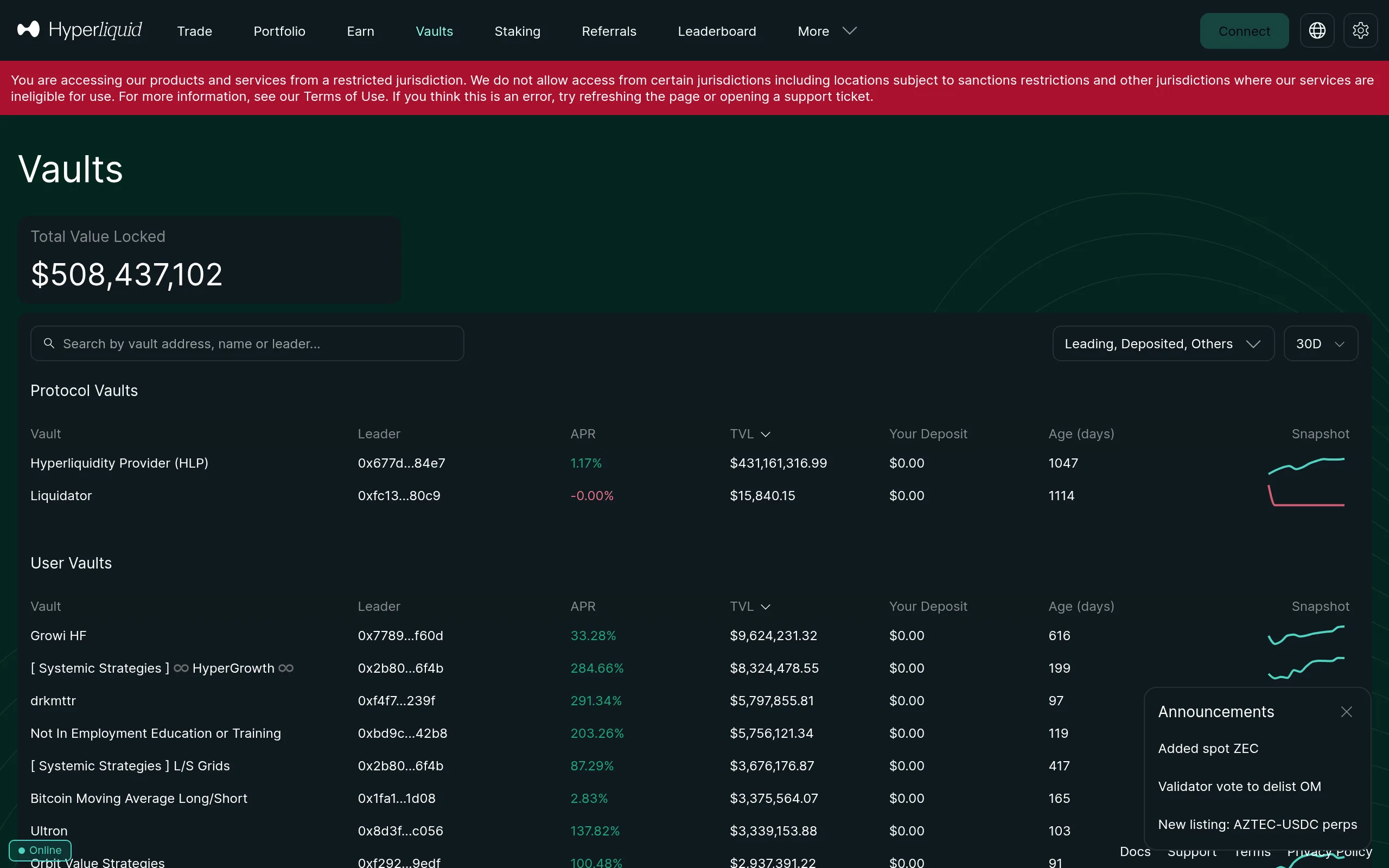
- Navigate to the Vaults page from the top navigation
- Find HLP at the top of the vault list - it is the protocol's flagship vault
- Look at the APR column, which shows the annualized return based on recent performance
- Click into the vault for a detailed breakdown: historical returns, TVL, current positions, and equity curve
The displayed APR is based on recent performance and changes continuously. A high APR during a volatile week may normalize during calmer periods. Check the 30-day and 90-day return history (not just the 24-hour figure) for a more realistic picture.
For DeFi lending rates, check the supply APY directly on the  Felix or
  HyperLend dashboards - rates are displayed prominently on each pool page and update in real time.
Method 2: Community Vaults - Copy Top Traders
Hyperliquid hosts dozens of community vaults where individual traders manage pooled USDC on behalf of depositors. You deposit USDC, the vault leader trades, and you earn (or lose) a proportional share of the results - minus a 10% profit share to the leader.
Community vaults offer exposure to a wide range of strategies: momentum trading, mean-reversion, macro rotation, and more. Some vaults have delivered impressive returns, but performance varies dramatically. A vault that gained 50% in one quarter can lose 30% the next.
Key considerations:
- Vault leader risk - You are trusting a specific individual's trading judgment. Leaders are not vetted or endorsed by Hyperliquid.
- No lock-up - Withdraw anytime, but withdrawing during a drawdown crystallizes losses.
- Diversification helps - Spreading capital across several vaults with different strategies reduces single-strategy blowup risk.
Before depositing, evaluate the vault's track record length, maximum drawdown, and consistency - not just headline returns. A vault profitable for six months through multiple market regimes is far more credible than one with two weeks of data during a trending market.
For a deep dive into vault mechanics, evaluation criteria, and how to create your own vault, see our complete vaults guide.
Method 3: HyperEVM DeFi Lending
The HyperEVM ecosystem has matured into a full DeFi stack with lending protocols where you can supply USDC and earn interest from borrowers. This is the closest thing to "savings account" yield in the Hyperliquid ecosystem - lower returns, but also lower risk compared to vault strategies.
Tip
Felix Protocol - Vanilla Markets & Stability Pools
Felix Protocol is the largest DeFi protocol on Hyperliquid by TVL. For USDC yield, two products are relevant:
- Vanilla Markets - Supply USDC to lending pools powered by Morpho's architecture. Earn variable-rate interest from borrowers. Rates adjust dynamically based on pool utilization - more borrowing demand means higher yields for lenders.
- Stability Pools - If you mint or acquire feUSD (Felix's stablecoin), you can deposit it into Stability Pools to earn from borrower interest payments and liquidation proceeds. Returns tend to spike during volatile markets when liquidations are frequent.
Felix's lending infrastructure is well-suited for users who want relatively passive USDC yield without directional trading risk.
Lend USDC on Felix Protocol
Supply USDC to Vanilla Markets and earn variable-rate interest from borrowers on Hyperliquid's largest DeFi protocol.
Open Felix Protocol HyperLend - Variable-Rate Lending
HyperLend is a dedicated money market protocol on HyperEVM - think Aave for the Hyperliquid ecosystem. Supply USDC, earn interest from borrowers. Simple, familiar mechanics.
- Variable rates - APY fluctuates with borrowing demand. Stablecoin pools tend to have steadier rates than volatile asset pools.
- No lock-up - Withdraw anytime, subject to pool liquidity.
- Points program - HyperLend may offer additional rewards through its points system on top of base lending yield.
For most users looking for low-risk USDC yield, lending on HyperLend or Felix is the starting point.
Earn USDC Interest on HyperLend
Supply USDC to HyperLend's lending markets and earn variable-rate yield. Non-custodial, no lock-up, built for HyperEVM.
Open HyperLend Kinetiq - Yield Stacking with Liquid Staking
If you hold HYPE rather than USDC, Kinetiq's liquid staking opens up yield-stacking opportunities. Stake HYPE, receive kHYPE or wstHYPE, then use those liquid staking tokens as collateral across Felix or HyperLend to borrow USDC - and deploy that borrowed USDC into additional yield strategies.
This is an advanced approach that compounds returns but also compounds risk. Each layer (staking, collateral, borrowing, redeployment) adds yield and smart contract exposure. Only pursue this if you understand the liquidation mechanics and are comfortable managing multi-protocol positions.
Method 4: Funding Rate Arbitrage
Funding rate arbitrage is a more advanced strategy that captures yield from the funding rate mechanism built into perpetual futures. The concept: hold a spot position and simultaneously short the same asset via perps. The two positions cancel out price exposure, and you earn the funding rate that flows from long to short traders.
During bullish markets - when most traders are long - funding rates tend to be positive, meaning shorts collect payments from longs. Annualized yields have exceeded 15-30% during sustained bull runs. During bearish periods, rates can flip negative and the strategy loses money.
Key characteristics:
- No directional risk - The spot long and perp short cancel out price movement.
- Variable yield - Returns depend entirely on funding rate direction and magnitude.
- Requires active management - Monitoring rates, rebalancing positions, and unwinding when funding turns negative.
- Can be automated - Protocols like Cathena on HyperEVM automate delta-neutral positions so you do not have to manage them manually.
For a comprehensive breakdown of delta-neutral strategies, automated vaults from D2 Finance and Gamma Strategies, and other advanced yield approaches, see our HyperEVM yield strategies guide.
Yield Comparison: All Methods Side by Side
Here is how the major USDC yield methods compare across return potential, risk, and complexity.
| Method | Typical APY Range | Risk Level | Lock-Up | Complexity | Requires HyperEVM |
|---|---|---|---|---|---|
| HLP Vault | Variable (depends on volume) | Medium - market-making drawdowns | None | Low - one-click deposit | No |
| Community Vaults | Highly variable | Medium to High - strategy-dependent | None | Low - choose vault, deposit | No |
| Felix Vanilla Markets | Low single-digit % | Low to Medium - smart contract risk | None | Medium - bridge + deposit | Yes |
| HyperLend Lending | Low single-digit % | Low to Medium - smart contract risk | None | Medium - bridge + deposit | Yes |
| Felix Stability Pools | Variable (spikes during volatility) | Medium - liquidation exposure | None | Medium - mint/acquire feUSD | Yes |
| Funding Rate Arbitrage | 5-30%+ (highly variable) | Medium - funding rate reversal | None | High - manage spot + perp | Automated: Yes |
Warning
How to Get Started
Getting USDC earning yield on Hyperliquid is a straightforward process, regardless of which strategy you choose.
1Deposit USDC to Hyperliquid
If you do not already have USDC on Hyperliquid, follow our deposit USDC guide. You will bridge USDC from Arbitrum into your Hyperliquid account - it takes under two minutes with zero deposit fees.
2Choose Your Strategy
- Want the simplest option? Deposit into HLP directly from your trading balance. One click, no bridging.
- Want lower-risk lending yield? Bridge to HyperEVM and supply USDC to Felix Vanilla Markets or HyperLend.
- Want to follow a trader? Browse community vaults and pick one (or several) with a strong, consistent track record.
- Want maximum yield and can manage complexity? Explore funding rate arbitrage or advanced yield strategies on HyperEVM.
3Start Small and Diversify
Do not put all your USDC into a single strategy. A balanced approach might look like:
- Core allocation (50-60%) - Lending on Felix or HyperLend for steady, lower-risk yield
- Growth allocation (20-30%) - HLP vault for market-making exposure
- Satellite allocation (10-20%) - A community vault or funding rate strategy for higher potential returns
This is not financial advice - your allocation should reflect your own risk tolerance, time horizon, and understanding of each strategy. The point is diversification: if one strategy has a bad month, the others may compensate.
What to Watch Out For
Before committing USDC to any yield strategy on Hyperliquid, keep these principles in mind:
Understand where the yield comes from. HLP yield comes from market-making spread and rebates. Lending yield comes from borrower interest. Funding rate yield comes from leveraged traders paying to hold positions. If you cannot trace the source of the yield back to a specific economic activity, the risk is probably higher than you think.
Smart contract risk is real. HyperEVM protocols are newer than established Ethereum DeFi. While major protocols have undergone audits, the ecosystem is still maturing. Spread capital across multiple protocols rather than concentrating in one.
APY numbers are backward-looking. A lending pool showing 8% APY today could show 2% next week if borrowing demand drops. HLP returning 15% annualized last month could have a drawdown this month. Yield is not income - it fluctuates.
Tax implications vary. Depending on your jurisdiction, yield from DeFi lending, vault profits, and funding rate income may be taxable events. Consult a tax professional familiar with crypto DeFi, especially for more complex strategies like yield stacking.
Important
Put Your USDC to Work on Hyperliquid
From one-click vault deposits to DeFi lending - start earning yield with a 4% lifetime fee discount.
Open HyperliquidFrequently Asked Questions
Yes. Hyperliquid offers multiple ways to earn yield on USDC. You can deposit into the HLP market-making vault, allocate to community trading vaults, lend USDC on HyperEVM protocols like Felix and HyperLend, or run funding rate arbitrage strategies. Each method has a different risk and return profile.
APY varies by strategy and market conditions. Lending USDC on Felix or HyperLend typically yields low-to-mid single-digit APY. HLP vault returns fluctuate with trading volume and volatility - there is no fixed rate. Funding rate arbitrage can produce double-digit annualized yields during bullish markets but can turn negative during bearish periods. No strategy offers a guaranteed rate.
No yield strategy on Hyperliquid is risk-free. Lending protocols carry smart contract risk and utilization risk. HLP is exposed to market-making drawdowns. Community vaults depend on the vault leader's trading skill. Funding rate arbitrage can lose money when rates flip negative. Always understand the specific risks of each strategy and never commit more capital than you can afford to lose.
It depends on the strategy. Depositing into HLP or community vaults is done directly on Hyperliquid's trading layer - no bridging needed. Lending on Felix or HyperLend and participating in DeFi yield strategies requires bridging USDC to HyperEVM first. See the bridge to HyperEVM guide for step-by-step instructions.
The simplest option is depositing USDC into the HLP vault through the Hyperliquid interface - it takes one click and requires no bridging. For lower-risk yield, lending USDC on HyperLend or Felix Vanilla Markets is straightforward but requires bridging to HyperEVM first.
Disclaimer: This content is for informational purposes only and does not constitute financial advice. Trading perpetual futures involves substantial risk of loss. Past performance is not indicative of future results. Always do your own research before trading. This site contains referral links - see our disclosure for details.
Ready to Start Trading?
Join Hyperliquid with our referral link and get a 4% lifetime fee discount. No KYC, no email - just connect your wallet and trade.
Start Trading - Save 4%