Hyperliquid Slippage Explained - How to Minimize It (2026 Guide)
Table of Contents
- What Is Slippage?
- Order Book Slippage vs AMM Slippage
- Key Differences
- Why This Matters
- How to Estimate Slippage Before You Trade
- Reading the Order Book
- Worked Example: $50,000 BTC Market Buy
- How to Minimize Slippage on Hyperliquid
- 1. Use Limit Orders
- 2. Use TWAP for Large Orders
- 3. Use Scale Orders for Range-Based Entry
- 4. Trade During Peak Liquidity Hours
- 5. Break Up Large Orders Manually
- 6. Check the Spread Before Trading
- Slippage and Leverage: A Hidden Multiplier
- The Real Cost of Entry and Exit
- When Slippage Is Unavoidable
- Slippage on HyperEVM DEXes: ArmSwap and the AMM Side of Hyperliquid
- Slippage on Different Hyperliquid Markets
- Summary
 Hyperliquid
Slippage is the silent cost that most traders never measure - but it affects every single market order you place. On a volatile asset, slippage on a single trade can cost more than the trading fee itself. Understanding how slippage works on Hyperliquid, how to estimate it before you trade, and how to minimize it will save you real money over hundreds of trades.
This guide covers slippage mechanics on Hyperliquid's order book, how it differs from AMM-based DEXs, and practical techniques to keep execution costs low - especially on larger positions.
Info
Quick Summary - Slippage on Hyperliquid
- Slippage is the difference between the expected price and your actual fill price
- On BTC-USD, a $10,000 market order typically sees less than 0.01% slippage (~$1 or less)
- A $100,000 market order on BTC may see 0.02-0.05% slippage depending on book depth
- Altcoin perps have wider spreads and more slippage - always check the order book first
- Limit orders eliminate slippage entirely - you set your exact price
- TWAP and scale orders reduce slippage on large positions by spreading execution over time
- Trade during US/EU market overlap (14:00-17:00 UTC) for the deepest liquidity
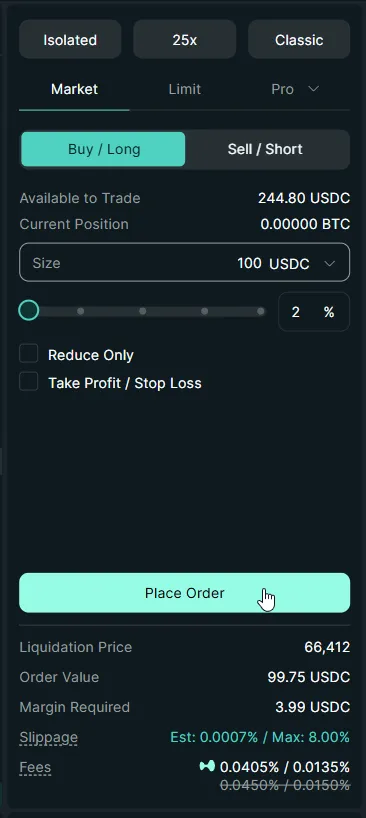
What Is Slippage?
Slippage is the difference between the price you expect when you click "Buy" or "Sell" and the price you actually receive. It occurs because market orders fill against whatever liquidity is available in the order book, starting from the best price and working through progressively worse price levels until the entire order is filled.
Example: You want to market buy $20,000 of ETH-USD. The best ask is $2,500.00 with $8,000 available. The next level is $2,500.25 with $12,000 available. Your order fills $8,000 at $2,500.00 and $12,000 at $2,500.25, giving you a weighted average entry of $2,500.15. The displayed price was $2,500.00, so your slippage is $0.15 per ETH - or 0.006%.
That 0.006% sounds tiny, but on a $20,000 order it is $1.20 in extra cost on top of your trading fees. Scale that to a $200,000 position and the slippage multiplies - potentially to $50 or more, depending on how deep the book is at that moment.
Order Book Slippage vs AMM Slippage
If you have traded on AMM-based decentralized exchanges like  Uniswap, you are familiar with setting a "slippage tolerance" before every swap. On an AMM, slippage is baked into the pricing formula - the constant product formula (x * y = k) mathematically guarantees that every trade moves the price, and larger trades move it more.
Hyperliquid works fundamentally differently. It uses a central limit order book (CLOB), the same model used by  Binance, the NYSE, and every traditional exchange. On an order book, slippage depends on the depth and distribution of resting limit orders placed by other traders and market makers - not a formula.
Key Differences
| Factor | AMM (Uniswap) | Order Book (Hyperliquid) |
|---|---|---|
| How price is set | Mathematical formula (x * y = k) | Supply and demand from resting orders |
| Slippage behavior | Predictable - increases with trade size along a curve | Variable - depends on order book depth at the moment |
| Small trades | Often similar slippage to order books | Usually very tight (sub-cent on majors) |
| Large trades ($50K+) | Slippage can be severe unless pool is huge | Slippage depends on market maker depth - typically much less |
| Price recovery | Pool rebalances continuously | New limit orders refill the book (usually within seconds) |
| Slippage setting | User sets max tolerance (e.g., 0.5%) | No tolerance setting needed - you see the book before trading |
Why This Matters
On an AMM with $5 million in liquidity, a $50,000 swap causes roughly 1% price impact - that is $500 in slippage. On Hyperliquid's order book for BTC-USD, the same $50,000 trade might cause 0.01-0.03% slippage ($5-$15), because market makers are continuously quoting tight spreads with significant depth.
The advantage of an order book is that slippage is not deterministic. A well-timed order during high-liquidity hours can have almost zero slippage even at $50,000+, while the same order during a thin session might slip more. You can see the exact depth before you trade and make an informed decision.
How to Estimate Slippage Before You Trade
On app.hyperliquid.xyz, the order book is displayed in real time on the right side of the trading interface. It shows the bid and ask prices along with the size available at each price level. You can use this to estimate your slippage before placing a market order.
Reading the Order Book
The order book has two sides:
- Bids (green) - Resting buy orders. If you market sell, your order fills against these.
- Asks (red) - Resting sell orders. If you market buy, your order fills against these.
Each row shows a price level and the cumulative size available up to that level. To estimate slippage on a market buy of $50,000:
- Look at the ask side of the order book
- Start from the best ask (lowest price) and add up the available size at each level
- When the cumulative size reaches $50,000, note the price at that level
- The difference between the best ask and that level is your expected slippage
Worked Example: $50,000 BTC Market Buy
Suppose the BTC-USD order book looks like this on the ask side:
| Price | Size Available | Cumulative |
|---|---|---|
| $85,000.0 | $15,000 | $15,000 |
| $85,001.0 | $12,000 | $27,000 |
| $85,002.0 | $18,000 | $45,000 |
| $85,003.0 | $20,000 | $65,000 |
Your $50,000 market buy fills $15,000 at $85,000, $12,000 at $85,001, $18,000 at $85,002, and the remaining $5,000 at $85,003. Your weighted average price is approximately $85,001.47 - a slippage of $1.47 from the best ask, or about 0.0017%.
That is $0.87 in slippage cost on a $50,000 trade. Compare that to the taker fee of 0.045%, which is $22.50 on the same trade. In this case, slippage is a minor fraction of total execution cost.
Tip
Trade with Deep Liquidity
Hyperliquid's on-chain order book handles billions in daily volume with tight spreads. Start trading with a 4% lifetime fee discount.
Join HyperliquidHow to Minimize Slippage on Hyperliquid
1. Use Limit Orders
The simplest and most effective way to eliminate slippage: use limit orders instead of market orders. A limit order lets you set the exact price at which you want to buy or sell. Your order will not execute at any price worse than what you specify.
If you want near-instant execution without slippage, place a limit order a few ticks above the best ask (for buys) or below the best bid (for sells). You get speed comparable to a market order with price certainty - and you pay the lower maker fee of 0.015% instead of the 0.045% taker fee.
2. Use TWAP for Large Orders
For positions above $50,000 - or above $10,000 on less liquid altcoin perps - a single market order may cause noticeable slippage and even move the market against you. TWAP (Time-Weighted Average Price) orders break your trade into smaller slices executed evenly over a time window.
Example: Instead of market buying $200,000 of SOL-USD at once, set a TWAP to execute over 30 minutes with 10 sub-orders. Each $20,000 slice fills against a refreshed order book, and your average entry tracks the market's average price rather than a single point of poor liquidity.
3. Use Scale Orders for Range-Based Entry
Scale orders distribute multiple limit orders across a price range. If you are building a position and are not in a rush, a scale order lets you accumulate at increasingly favorable prices during a pullback - with zero slippage on each individual fill.
4. Trade During Peak Liquidity Hours
Order book depth is not constant. It varies by time of day, day of week, and market conditions. The deepest liquidity on Hyperliquid - and on crypto markets generally - occurs during the overlap of US and European trading hours.
Peak liquidity windows (UTC):
- 14:00-17:00 UTC - US market open overlapping with European afternoon. Tightest spreads, deepest books.
- 08:00-12:00 UTC - European session. Good liquidity on majors.
- 13:00-21:00 UTC - US session. Strong liquidity throughout.
Thinner liquidity periods:
- 00:00-06:00 UTC - Asian session. Liquidity is decent but noticeably thinner on USD-denominated perps.
- Weekends - Market makers reduce quoting activity. Spreads widen, depth thins.
- Around major news events - Market makers pull orders ahead of FOMC, CPI, or major crypto events, causing temporary depth gaps.
Warning
5. Break Up Large Orders Manually
If TWAP is not available for your specific use case, you can manually split a large order into smaller chunks. Instead of one $100,000 market buy, place five $20,000 orders a few seconds apart. This gives the order book time to refresh between fills.
6. Check the Spread Before Trading
The bid-ask spread - the gap between the highest bid and lowest ask - is a quick proxy for slippage risk. On BTC-USD during peak hours, the spread is typically $0.10-$1.00 (less than 0.001%). On a low-cap altcoin perp, the spread might be 0.05-0.10% or wider. A wider spread means your first fill is already at a less favorable price.
Slippage and Leverage: A Hidden Multiplier
Slippage has an outsized impact on leveraged positions. When you trade with leverage, the slippage cost is deducted from your margin - not from your notional position size. This means leverage amplifies the effective cost of slippage relative to your capital.
Example: You open a $100,000 BTC long at 20x leverage with $5,000 margin. Your market order slips 0.03%, costing $30 in slippage. That $30 is:
- 0.03% of your notional position - seems small
- 0.6% of your $5,000 margin - significant
At 50x leverage, the same $30 slippage would be 1.5% of your $2,000 margin. Add the 0.045% taker fee ($45) and your total entry cost is $75 - 3.75% of your margin consumed before the trade even moves in your favor.
This is why experienced traders using high leverage almost always use limit orders. The combination of zero slippage and lower maker fees keeps entry costs minimal, preserving margin for the trade itself rather than burning it on execution costs.
The Real Cost of Entry and Exit
Remember that slippage hits you twice if you use market orders for both entry and exit. The total round-trip cost of a leveraged trade includes:
- Entry slippage (market buy)
- Entry taker fee (0.045%)
- Exit slippage (market sell)
- Exit taker fee (0.045%)
- Funding rate cost (if holding the position)
For a 20x leveraged position, a round trip with 0.03% slippage each way plus taker fees costs:
Total = (0.03% + 0.045% + 0.03% + 0.045%) × 20 = 3.0% of margin
Using limit orders instead (zero slippage, 0.015% maker fee):
Total = (0% + 0.015% + 0% + 0.015%) × 20 = 0.6% of margin
That is a 2.4% margin savings per round trip - a substantial edge over time.
Reduce Your Trading Costs
Lower fees plus smart execution equals more margin working for you. Get a 4% lifetime fee discount on Hyperliquid.
Start Trading - Save 4%When Slippage Is Unavoidable
There are situations where you will accept slippage as a cost of doing business:
- Urgent exits - If your position is moving against you and approaching liquidation, a market order to close the position is worth any amount of slippage. Getting out at a slightly worse price beats getting liquidated.
- Fast-moving markets - During a breakout or breakdown, the price may be moving so quickly that a limit order will not fill. A market order guarantees execution.
- Stop-loss execution - Stop-market orders are designed to execute immediately when triggered. The small slippage on a stop-loss is the price of guaranteed execution - and that guarantee is worth it for risk management.
In these cases, slippage is the cost of speed and certainty. The goal is not to eliminate slippage on every trade but to be intentional about when you accept it and when you avoid it.
Slippage on HyperEVM DEXes: ArmSwap and the AMM Side of Hyperliquid
Slippage works very differently on the HyperEVM DEX side of the Hyperliquid ecosystem than it does on the native L1 order book. ArmSwap is one of the largest HyperEVM-native DEX aggregators and a useful reference point for understanding AMM slippage in this ecosystem. ArmSwap routes spot swaps across HyperEVM liquidity pools — including Felix, HyperLend's collateral markets, and direct pair pools — and surfaces a slippage estimate before every swap based on the depth of the chosen route.
The mechanics are AMM-style: the more of a pool's reserves you consume in a single swap, the more the constant-product curve pushes the price against you. For a $1,000 swap on a deep pair like HYPE/USDC, ArmSwap typically quotes slippage well under 0.2%. For the same pair, a $50,000 swap can show 1–3% expected slippage depending on which sub-pool the router picks. Thin altcoin pairs on HyperEVM can easily show 5% or more on five-figure swap sizes — the same dynamic that makes Uniswap risky for large orders.
The practical implication: if you are trading a token that exists as both a Hyperliquid spot pair and a HyperEVM token, the order book on Hyperliquid spot will almost always give you a better fill on size than an HyperEVM AMM swap. Use HyperEVM DEXes like ArmSwap for tokens that only live on HyperEVM (HyperEVM-native projects, LP tokens, governance assets) where there is no L1 spot market to route through. For everything else, the central limit order book wins on slippage — that is the core architectural advantage covered earlier in this guide.
Slippage on Different Hyperliquid Markets
Not all markets on Hyperliquid have the same depth. Slippage varies significantly by asset:
| Market Tier | Examples | Typical Spread | $10K Market Order Slippage |
|---|---|---|---|
| Major pairs | BTC-USD, ETH-USD | $0.10-$1.00 | Less than 0.01% |
| Large caps | SOL-USD, DOGE-USD, AVAX-USD | $0.01-$0.05 | 0.01-0.03% |
| Mid caps | ARB-USD, OP-USD, INJ-USD | $0.005-$0.02 | 0.03-0.10% |
| Small caps | Low-volume altcoins | $0.01-$0.05 | 0.10-0.50%+ |
| HIP-3 builder markets | Commodities, equities | Varies widely | Check book before trading |
The HLP vault acts as one of the primary liquidity providers on Hyperliquid, quoting on both sides of the book across most markets. This protocol-level market making is a key reason why spreads and slippage are competitive with - and often better than - centralized exchanges.
Info
Summary
Slippage is one of the most underappreciated costs in trading. On Hyperliquid's order book, slippage on major pairs is minimal for most trade sizes - but it scales with order size, leverage, and market conditions. The traders who consistently outperform are the ones who treat execution quality as seriously as trade direction.
The key principles:
- Use limit orders for most entries and exits - zero slippage, lower fees
- Use TWAP or scale orders for positions above $50,000 (or $10,000 on altcoins)
- Trade during peak liquidity hours (14:00-17:00 UTC) for the tightest spreads
- Check the order book depth before any large market order
- Account for leverage - slippage as a percentage of margin, not notional
- Accept slippage when speed matters: stop-losses, urgent exits, fast-moving markets
For a complete walkthrough of all order types including limit, TWAP, and scale orders, see the order types guide. And if you are new to Hyperliquid, start with the beginner trading guide to set up your account and place your first trade.
If you do not have a Hyperliquid account yet, make sure to use a referral link when signing up. The 4% lifetime fee discount applies to every trade - reducing your overall execution costs alongside the slippage savings from smarter order management.
Frequently Asked Questions
Slippage on Hyperliquid is the difference between the expected price of a trade and the actual execution price. It occurs when a market order is large enough to consume multiple price levels in the order book. For example, a $10,000 BTC market buy might fill at $50,001 instead of the displayed $50,000, resulting in 0.002% slippage. Hyperliquid's deep order book on major pairs keeps slippage minimal for most trade sizes.
Use limit orders instead of market orders to guarantee your execution price. For large market orders, break them into smaller pieces or use TWAP orders to spread execution over time. Trade during high-liquidity hours (US and European market overlap) for tighter spreads. Check the order book depth before placing large orders to estimate expected slippage.
Yes, for most trade sizes. Hyperliquid uses a central limit order book (CLOB) rather than an automated market maker (AMM). On an order book, slippage depends on the depth of resting limit orders, which is typically very deep on major pairs. AMMs like Uniswap calculate price based on a mathematical formula (x*y=k), which means slippage increases predictably with trade size and can be much higher for large trades.
Yes. When placing market orders on Hyperliquid, there is an implicit slippage tolerance that prevents your order from filling at extremely unfavorable prices. Additionally, you can use limit orders to set your exact maximum price, eliminating slippage entirely. For large positions, TWAP and scaling orders let you execute gradually to minimize market impact.
Disclaimer: This content is for informational purposes only and does not constitute financial advice. Trading perpetual futures involves substantial risk of loss. Past performance is not indicative of future results. Always do your own research before trading. This site contains referral links - see our disclosure for details.
Ready to Start Trading?
Join Hyperliquid with our referral link and get a 4% lifetime fee discount. No KYC, no email - just connect your wallet and trade.
Start Trading - Save 4%